Our Methodology Explained
Learn about how we calculate carbon footprints for our recipes
The estimated carbon footprint of each recipe is an important part of "Climate-Friendly Cooking". This article explains how we calculate our estimates.
In a Nutshell
The carbon footprint of the recipes on this blog is estimated but not perfect. We aim to cover the carbon emissions from ingredients and preparation, providing a typical carbon footprint for each recipe. However, please note that this is an approximation and may not be accurate to the gram in individual cases. There is variation based on the method of food production as well as the carbon intensity of the electricity production in your country. Our estimates do not account for your individual transport to/from the store, food storage at home and for cooking utensils.
It's important to note that the carbon footprint is an estimate and depends on various factors, such as the amount of fertiliser used to grow vegetables and the energy efficiency of your cooking pot. It is not possible to map everything exactly. The main goal is to arrive at the correct order of magnitude and enable comparisons.
Many recipes on the blog are designed for two servings, which is practical for couples or individuals who want leftovers. The quantities can be easily adjusted for more people.
The estimated carbon footprint is primarily related to the emissions generated by the ingredients and preparation. The following sections provide more detail about each of these parts. Finally, there is an overview of what is not included in this estimate.
The Carbon Footprint of Ingredients
To calculate an ingredient's carbon footprint, we use publicly available scientific studies that provide data on carbon equivalents. These studies are typically in the form of life cycle analyses, which measure emissions production to sale at the checkout.
We have compiled a list of more than 1900 ingredients and their respective carbon footprints from various scientific studies.
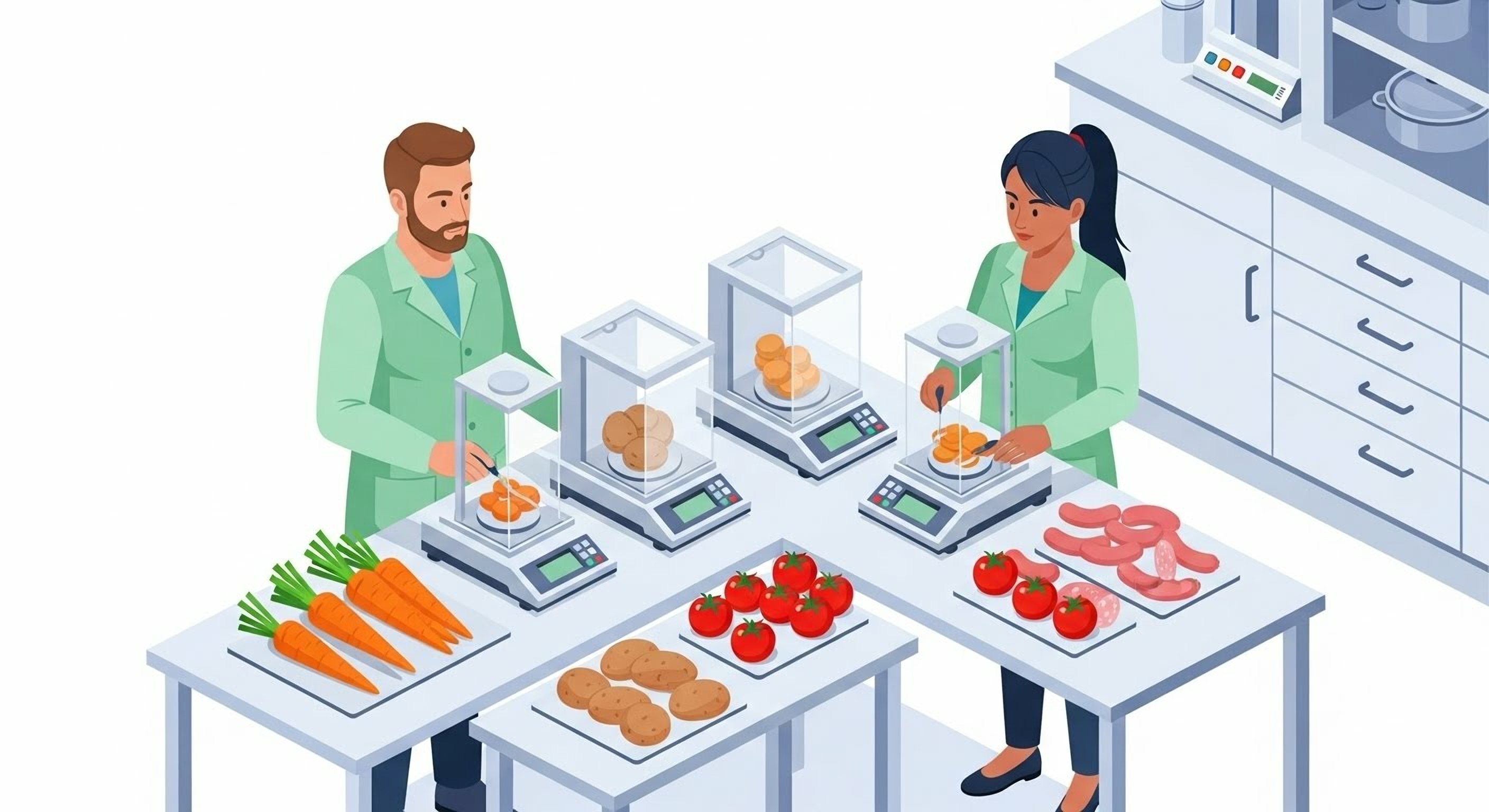
Some of these are available in different varieties, such as conventionally grown lentils versus organic lentils or field-grown tomatoes versus greenhouse tomatoes. The list is extensive but not exhaustive. For instance, there is no study comparing the carbon footprint of basil to thyme. In such cases, we use estimates for broader categories, such as 'herbs and spices', which are also based on these studies. This is especially true for ingredients used in small quantities. Even if there is a significant difference between basil and thyme, it is unlikely to affect the recipe's carbon footprint.
Life cycle analyses estimate emissions for each food, but the actual value depends on the production process (source). We assume a typical carbon footprint value, acknowledging that there may be some variation around this value. We sometimes need to combine data from multiple sources for a recipe, and the methodological approaches of these studies may differ slightly, leading to another source of inaccuracy.
It is important to note that the carbon footprint provided in the overview refers to one kilogram of the ingredient. In the next step, we convert this to the quantities actually used in the recipe.
The Carbon Footprint of Food Preparation
While there are extensive studies on the carbon footprint of food production, there is relatively little work on cooking methods. Most of our data is taken from a Swiss study of electricity consumption of different cooking methods (source).
We perform various calculations on top of this data to use it more flexibly: For instance, the study is investigating the electricity consumption of pre-heating an oven and then baking pizza in it. We have broken this down into the single components so we can estimate the energy consumption of different baking times.
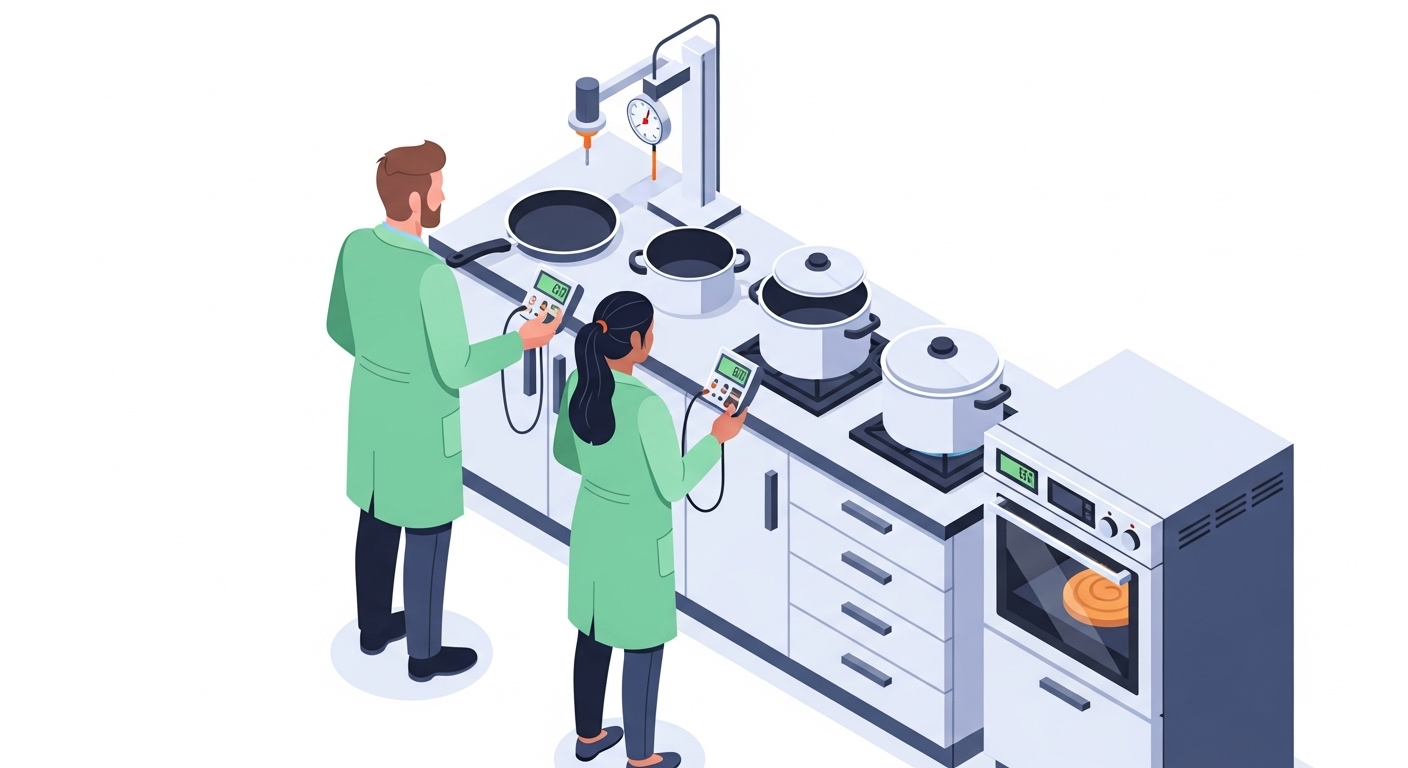
The study itself is based on a specific cooker and oven model: It is the Electrolux SB7 cooker with a ceramic hob and an oven capacity of 70 litres. Your individual case will probably be different. If you happen to know of any other scientific work on this topic, please let u know at hello@climate-friendly-cooking.com.
To calculate the carbon footprint based on the power consumption for cooking, we leverage data on the carbon intensity of the eletrical grid, which is estimated at 237g CO2 equivalents per kilowatthour in the EU-27 in 2023 (source). (Previous versions were using an estimated carbon intensity of the German energy mix of 366g CO2e per kilowatthour in 2020, based on data by the German Federal Environment Agency).
This is a helpful approach, but it will not be precise for every single case:
- We use the average carbon intensity in the European Union, but you actually live in a specific country with a specific energy mix. However, there is considerable variation within Europe: Poland has a carbon intensity of 615g CO2e per kilowatthour because they still use coal plants, while Sweden's carbon intensity is only 36g CO2 due to its heavy use of renewable water power. This is a 17-fold difference between the countries!
- We use data from 2023 to use a fixed reference, but the carbon intensity of the energy mix is evolving: For Europe, this was 419g CO2 per kilowatthour in the year 2000 and decreased to 237g in 2023. This is a decrease of 43% or, in other words, an improvement of about 1.8 percentage points per year. Your energy mix will keep evolving, but we think it is advantegeous to use a fixed carbon intensity to enable like-for-like comparisons between recipes.
What Is Not Included In Our Estimate?
The focus of the carbon footprint is on the ingredients and their preparation. In fact, there are more sources of carbon emissions from our food, but we cannot look at them here:
- Your trip to the supermarket: It makes a difference which mode of transport you use to get to the supermarket - but it also depends on how often and how much you shop. It's very hard to generalise. (I usually walk to the shop.)
- Storing food: You probably store some things in the fridge and some in the cupboard. However, allocating the annual consumption of your fridge to each food item is complicated: It depends on how big and how full your fridge is, and how long you keep a food item in the fridge.
- Your kitchen appliances, your cooking utensils, your crockery and cutlery: These are all consumer goods that are often used for a very long time. Even if you can estimate the carbon emissions involved in making a cooker, it is difficult to allocate them to each cooking process (especially if it is used for more than 10 years).
- Your visit to this website: Using the internet also has a carbon footprint. In this case, it is only a few grams.
How Is Our Approach Different From Others?
Other recipes do not specify exact amounts of ingredients, but rather use proportions based on a typical dietary style or daily calorie requirement (e.g. Poore and Nemecek 2018 or "All You Can Eat" by Greenpeace Switzerland and Eaternity). This approach is useful for calculating an overall carbon footprint over a longer period of time.
In contrast, this blog focuses on individual recipes that can be easily incorporated into your daily diet.
Do you have specific suggestions and data that could be used to improve this estimate? Feel free to send us an e-mail to hello@climate-friendly-cooking.com.