Requiem for a Glacier
The glaciers in the Alps are melting and unfortunately you can watch them do it
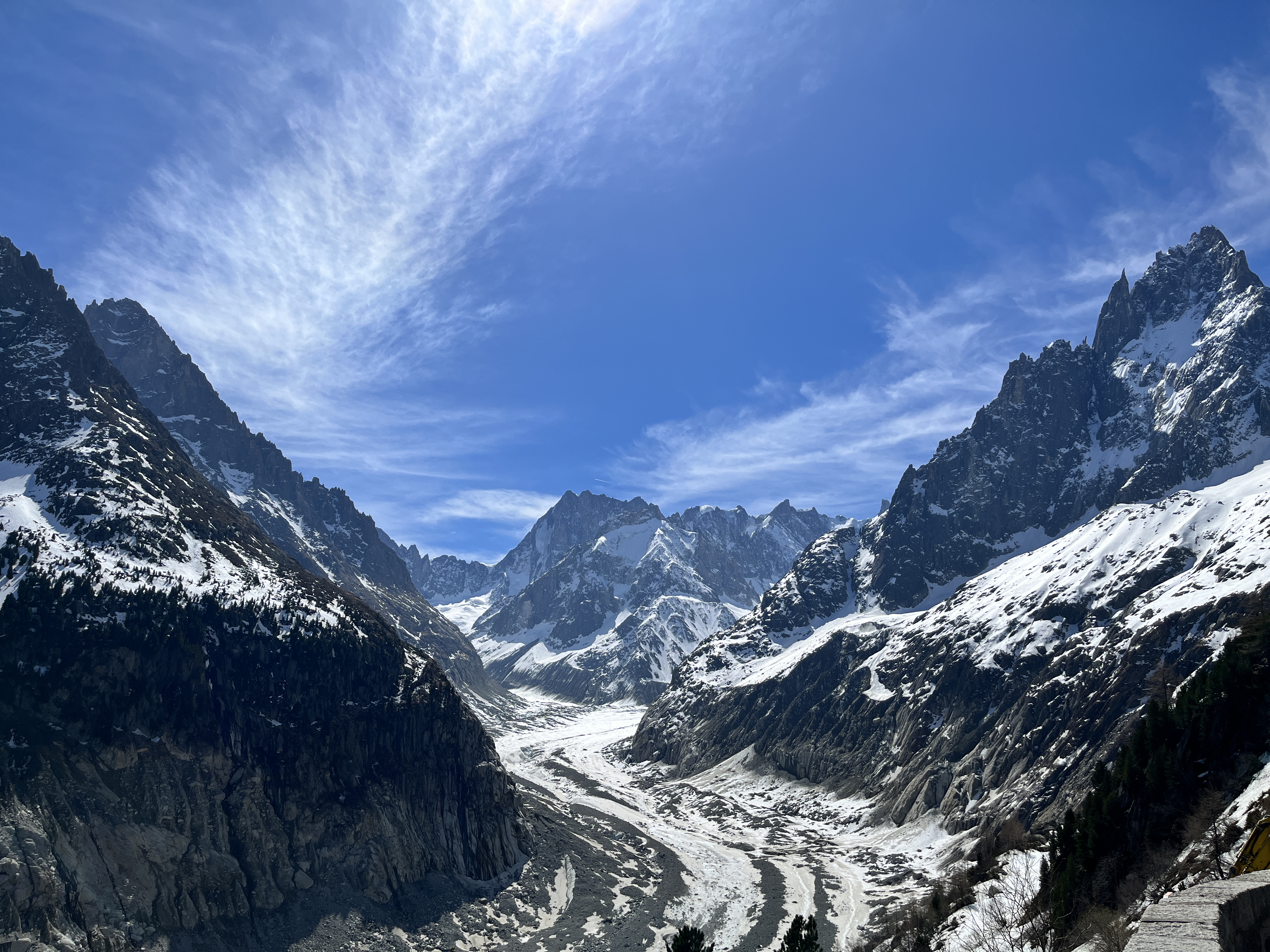
Image credit: Max Alletsee
The “Mer de Glace” in the Mont-Blanc massif is the largest glacier in France and the fourth largest glacier in the Alps - and it is melting.
At the Easter weekend, we took a trip to Chamonix, a small town at the foot of Mont Blanc. We wanted to visit the town, sit in the sun - and we wanted to take a trip to a dying glacier.
The “Mer de Glace”, French for “Sea of Ice”, is the largest glacier in France and the fourth largest in the Alps. It is located just above Chamonix and can be reached quite easily with the Montenvers cogwheel train and a small gondola. A special feature is the ice cave in the glacier tongue, where you can see the glacier from the inside.
If you take the mountain railway and the gondola, you are at the point where the glacier was at the beginning of the 20th century. From there, you set off on a path that is actually more of a funeral procession: you descend more than 500 steps to reach the tip of the glacier. This descent takes almost half an hour and is a “Walk of Shame” for humanity. Again and again, there are plaques on the rock that report on the state of the glacier in a certain year. The plaque for the year 1990 is very high up, after only about 5 minutes of walking. Shortly thereafter come 2000, 2003, 2005, …
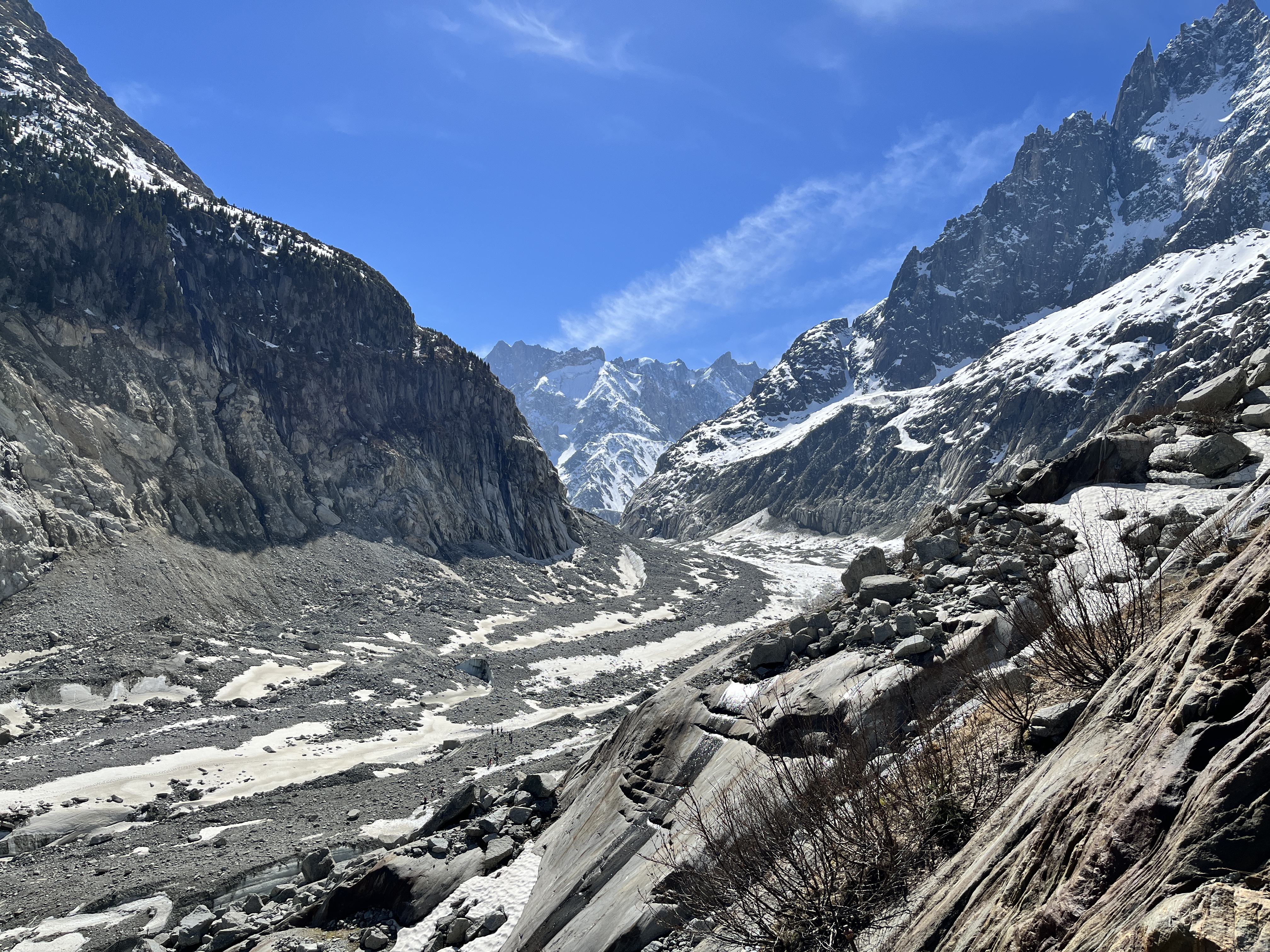 A view of the end of the Mer de Glace, taken at Easter 2022.
You climb further and further down the stairs and enter an area that was covered with ice just 30 years ago. In total, you walk for about 20-25 minutes until you finally reach the tongue of the glacier.
Every year, about 30-40 new steps are added to the 500 steps - that’s how many are needed to continue to reach the tongue of the “Mer de Glace” as it continues to melt. Looking back at the staircase construction, it becomes very clear what dramatic consequences climate change has.
When you stand at the foot of the “Mer de Glace”, it no longer feels like a sea of ice. The sun is shining, you can hear the ice melting and dripping. At the entrance to the cave in the glacier, there is a roof construction to protect visitors from falling drops. This doesn’t always work, the glacier is melting in too many places - and when a drop finds its way into my jacket, a cold shiver runs down my spine.
At home, I search for historical pictures of the “Mer de Glace” and see how it was indeed once a sea of ice and snow. I compare the pictures and find that the real commonality is the surrounding mountains - the glacier itself is hardly recognizable today.
The trip to the “Mer de Glace” showed me the dimension of the climate crisis. In reports about warming in the tenth of a degree range, about projections to the end of the century or about “parts per million” of CO2 in our atmosphere, there is no scale in our everyday life that illustrates the extent of the changes. When I stand on a melting glacier and think about where there was nothing but ice thirty years ago and today there is only bare rock, then this suddenly becomes very, very clear.
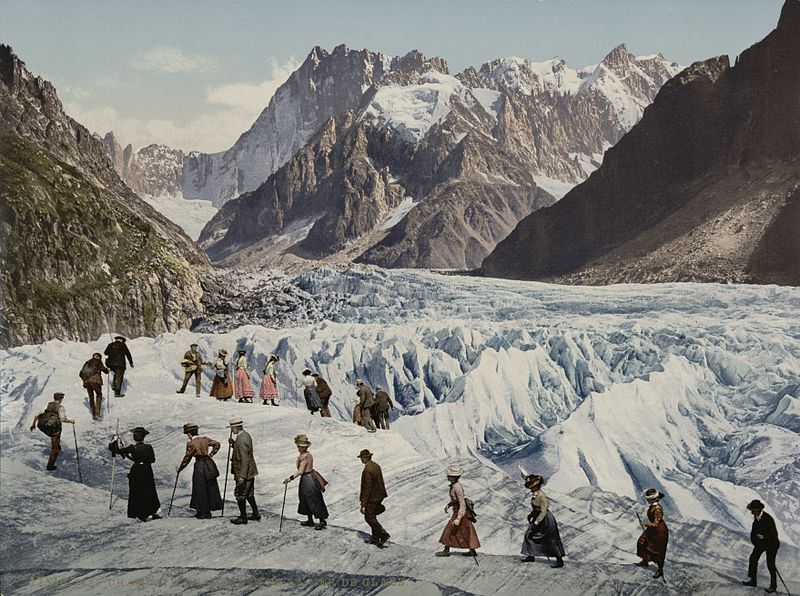 A crossing of the Mer de Glace, anonymous photographer between 1902 and 1904. Central Library Zurich.

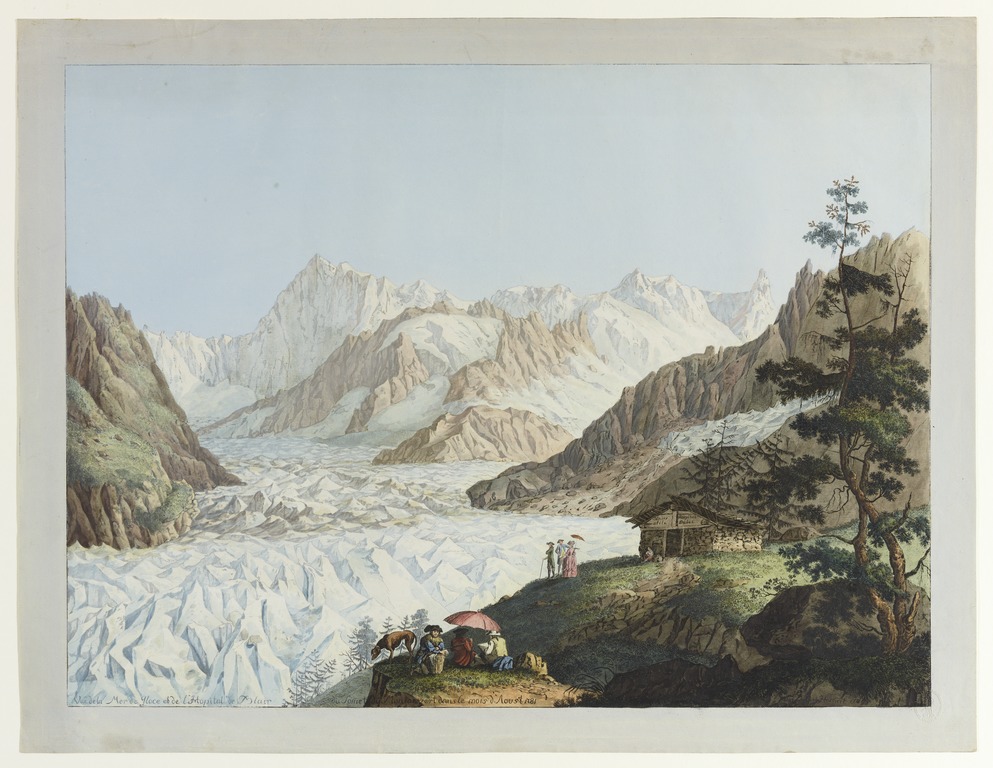 Carl Ludwig Hackert: ‘Vuë de la Mer de Glace et de l’Hopital de Blair du Sommet du Montanvert dans le mois d’Aoust 1781’, 1781. Swiss National Library